By Kuda Pembere
With donor fatigue looming, African governments should provide enough allocations towards tackling gender-based violence in their countries, a Kenyan sexual reproductive health rights advocate said.
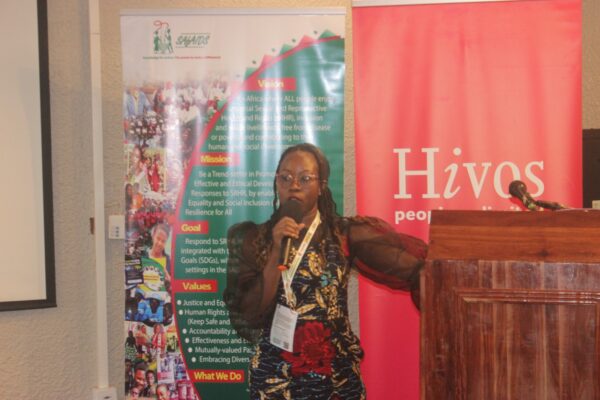
This was said by Ms Judie Amina during a HIVOS ICASA side event titled Redefining the Feminist Agenda: Co-creating Solutions to Ending Violence Against Women and Girls (EVAWG) in East and Southern Africa. Ms Amina said African governments should adequately fund programs to fight GBV issues in a manner that makes them sustainable.
“At the same time there is quiet reliance of donors in funding. This means an opportunity of looking at local funding and investments in ending violence against women and girls.
“And it doesn’t mean we don’t need support from donors, we still need that investment on ending violence against women and girls but in country we need budgets that are allocated for this.
“And not small budgets to show well…this country has 5 percent allocated, we needs budget that are enough to be allocated to support this work. And budgets that are sustainable and not just end after a period,” she said.
She decried how some African countries are still to renew their commitments to be held accountable on GBV issues.
“At the same time, we are seeing quite a trend of regression in different parts of Africa, actually in different parts of the world. There is regression not only in implementation of these policies but also commitment to them.
“For example, the ESA commitments done in 2003, and then in 2021 there was a recommitment of these policies. But only a few countries of the east and southern African parts have committed to it especially the eastern African countries, political issues.
“So we have Kenya did not recommit, Uganda did not recommit and this means that we no longer have a policy or commitment to hold governments accountable with.
“So that really brings regression. Countries need to recommit to these policies so that we ground our advocacy on, something we can hold them accountable to,” Ms Amina said.
Some African countries according to Ms Amina have depressive laws which instead of promoting sound social values, are doing just the opposite.
“And I know this is not news because the different countries represented in this room might be able to confirm this. For example, we have the anti-homosexuality bills, Uganda and also in Ghana.
“In Kenya, we also have Family Protection Policy that has already passed and also there is a proposed bill on family protection.
“I know it sounds really well when you say Family Protection but when you read the bill, there is nothing on the family. It’s actually burying more of the family values that are supposed to be promoted,” she said.
Sexual Reproductive Health Rights Allance Uganda Youth Country Co-odinator Ms Faith Mariah said gender-based violence issues are best tackled if gender power relations are addressed.
Institute of Women Social Workers programs manager Ms Ethel Musara said labelling the issue of marrying off adolescent young girls as child marriages is a misnomer. She said it should be called child violation or child molestation.
Chief Bushu said the Victim Friendly Unit of the Zimbabwe Republic Police was inadequately capacitated to an extent that they do not have a vehicle to travel with when attending GBV cases.
African governments urged to provide sustainable funding for GBV fight