
By Kuda Pembere
At a time when the world is witnessing a decline in development aid, the Republic of Ireland has reaffirmed its commitment to sustaining international support.
This assurance follows a trend that began in US President Donald Trump’s administration, which saw America, once the largest donor, cut its spending on international development initiatives. Several other countries followed suit.
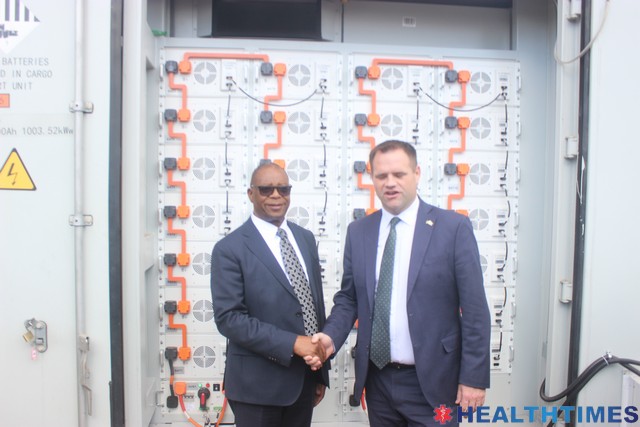
Speaking at the commissioning of a state-of-the-art incinerator at Sally Mugabe Central Hospital on Monday, Ireland’s Minister of State at the Department of Foreign Affairs and Trade, Neale Richmond, emphasized that Ireland would not follow that path.
“I think it’s pretty obvious, ladies and gentlemen, that we are in slightly interesting global times, to be quite frank. We are in challenging global times, and it requires a real response. A response from countries to Ireland to say, first and foremost, we are absolutely committed to the multilateral process.
“We are absolutely committed to the work of the United Nations and its agencies, and we will continue that commitment very, very loudly. We are also, ladies and gentlemen, committed to international development. When far too many countries are turning their backs on international development, Ireland has not cut its international development budget,” he said.
Since 1980, Ireland has invested over US$250 million into Zimbabwe’s development and humanitarian initiatives.
“That support, ladies and gentlemen, goes back decades. It goes back to the very first Irish missionaries who travelled here many, many years ago to work in the hospitals, to work in the health clinics, to work in the schools and in the communities that needed help at a time when they were often so forgotten by so many people. Very few of those missionaries are still with us today but they still play a powerful role here in life in Zimbabwe.
“But our role within Zimbabwe has evolved crucially over the years. Since 1980, the Irish Government has provided over $250 million worth of development assistance to our friends in Zimbabwe. Since 2015 alone, we’ve provided $33 million in support purely for health systems in Zimbabwe,” Richmond said.
Regarding the Global Fund, Richmond noted that Ireland has contributed US$400 million to date.
“And dear friends, I can absolutely confirm that this support will continue going forward. Ladies and gentlemen, Ireland, of course, is a founding member of the Global Fund. And I’d like to thank you so much for your kind words.
“Since our initial involvement in the foundation of the Global Fund, Ireland has contributed $400 million to that fund. And indeed, we look forward to making our annual contribution later in this year. And that commitment will continue, not just to the work of Global Fund, but so many, so many important partners that are thankfully represented here today and who are active here in Zimbabwe,” he said.

During his visit to Sally Mugabe Children’s Hospital, Richmond commended Zimbabwe for its progress in reducing malnutrition among children.
“And we will continue to work with our partners across the global north, be they within the European Union, wider EU, or beyond, to state the importance of international development, to state the importance of those partnerships. And I challenge anyone who takes joy in cutting international development to visit the malnutrition ward in Sally Mugabe Hospital. Look the children and look their parents in their eyes and tell them that this is a budgetary measure.
“Tell them that there are other priorities. Say that the real, real tangible progress that has been made here in terms of tackling mortality from malnutrition doesn’t matter or isn’t electorally proficient. It matters, ladies and gentlemen, and it matters for ministers from all parts of the world to come here and say that and to recommit to that absolute investment.
“And this is how we have to view it. It is an investment. It is an investment for Ireland to be committed to our friends in Zimbabwe.
“It is an investment for Ireland to be committed to international development and the multilateral system. And it is an investment that provides a very, very real return. That investment will continue,” he said.
“We will work absolutely with our partners here in Zimbabwe as we look to address what will be very real global financial challenges in the coming months, in the coming years. We will work to make sure that our Zimbabwean friends realise their ability to invest in their healthcare system. And we will be there every step of the way, not just morally, but financially.
“And that’s a commitment I want to leave here this evening by giving. And, crucially, what I really want to get across, Honourable Minister, is our gratitude to you to allow us to have the ability to partner with you, to allow us to work with the Global Fund, and to allow us to continue to work with our partners across the multilateral system. We have lots and lots of difficult days ahead, ladies and gentlemen, but where there are challenges, there are opportunities.”

Zimbabwe’s Health and Child Care Minister Dr Douglas Mombeshora said the reassuring words from his Irish counterpart that they will not reduce their spending would help the country sustain its health programs.
“I think we all know that Zimbabwe is among the top countries that have achieved the 95-95-95 targets. And this is collaborative work between our partners and our government. Our government, through the National AIDS Trust, have also availed resources to complement what is coming through Global Fund and other partners to make sure that this is possible. We also know that we have managed to reduce TB incidences by 20 percent, which is a huge milestone, and we hope we’ll be able to sustain this.
“And I think it’s going to be possible because today I had very good news from our partner, Global Fund, who said they will continue supporting this program. And also the minister, Honorable Richmond, said the government of Ireland is not going to cut on its development funds. Therefore, I think we are going to be able to sustain this program,” he said.


